

The MADE Framework for complex negotiations outlines key activities negotiation leaders should take at each step of the process. Following this guidance helps maximize deal value while preserving relationships.
THE MADE NEGOTIATION SERIES | INTRODUCTION
Negotiation Is a Process, Not an Event
Negotiation is not a single event. In most cases, it is a long cycle process with months (or even years) of preparation, set up, and positioning before you even find yourself “at the table”. Whether you are about to finalize terms with a key account, purchase a new asset, or close a new partnership deal, you benefit from taking a broad definition of “negotiation” that encompasses early actions, alignment, planning, and engagement in addition to the actual discussion of (and agreement to) specific terms.
It is easy to say “start earlier!” and “think broadly!” or even, “make sure you have internal alignment!” The challenge comes with figuring out how to do these things well while navigating a long to-do list. In our recent Customer-Supplier Negotiation Study, we found that organizations with a clear point of view on “what good looks like” from a process perspective tend to realize more deal value than their peers.
From 30+ years advising top global companies, we know that top negotiators think of negotiation as a multi-phase endeavor. While this process is never totally linear, we developed the Four Phases of Negotiation MADE Framework to help signpost the key activities negotiation leaders should take based on where they are in the process. Following this guidance helps maximize their defense of value while preserving relationships.
What Are the Four Phases of Negotiation?
The MADE Framework defines four phases of negotiation: Map, Align, Design, and Execute. Together, they help teams leading complex negotiations understand the context, build stakeholder alignment, design value-creating proposals, and execute effectively at the table.
THE MADE FRAMEWORK: THE FOUR PHASES OF NEGOTIATION
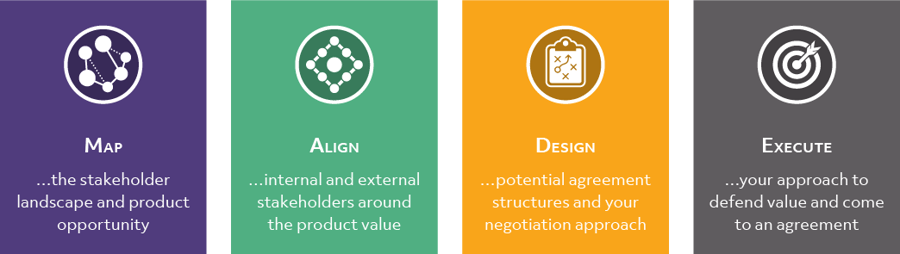
1. Map: Understand the Negotiation Landscape
Map the competitive landscape and stakeholder influence environment.
Confirmation bias can prevent us from fully understanding the larger context in which we are preparing to negotiate, creating blind spots and limiting value realization later.
-
Create a dossier of key market events that might impact your negotiation
-
Create a map of key stakeholders and their influencers to craft an early, cross-functional engagement strategy
-
Externally: Begin early engagement and messaging to test counterpart thinking and the core value proposition. Identify signals to monitor for that might indicate likely counterpart actions.
-
Internally: Build early agreement on assumptions and strategy. Describe and pressure-test three or four access scenarios ranging from best-case to worst-case. Are they realistic? What is the strategy for each situation?
In Practice: When a medical equipment company faced an RFP that threatened a significant share of its regional business, the team looked beyond procurement to uncover other stakeholders and what they valued. That broader view helped the company defend, and ultimately grow, the business.
2. Align: Build Internal and External Stakeholder Alignment
Align internal and external stakeholders around a shared definition of value.
Often, internal negotiations are equally or more difficult than the external negotiation. Teams succeed by bridging the gap between internal strategy and external cost pressures.
3. Design: Develop Your Negotiation Strategy and Proposals
Design your negotiation approach and several acceptable proposals.
We should not resign ourselves to strategies focusing solely on tactical price/rebate concessions. Product value can, and should, have a broad definition whenever possible.
- Structure several proposals that have different, balancing elements that distribute value to both parties (us very well, our counterparts, acceptably).
- Agree to the conditions required to navigate among possible proposals to enable tactical and efficient trading at the table.
- Being a “hard bargainer” is one way to approach negotiation… not the only way. Through a focus on value and techniques for managing difficult tactics, we can build a respectful rapport without sacrificing on substance.
In Practice: In one market access negotiation for a high-priced oncology treatment, the payer’s concerns went well beyond price. By uncovering and addressing concerns about treatment infrastructure, our client found another path to an agreement that worked for both sides.
4. Execute: Create and Defend Value at the Table
Execute your negotiation plan and adapt as needed.
With the foundations for your negotiation sufficiently laid, your job is to create and defend value.
What Does an Effective Negotiation Process Require?
Taken together, MADE defines how to operate in any market, especially with complex negotiations. Intentionally working through these four phases ensures that we:
- Shape context before formal talks begin so the negotiation happens on firmer ground.
- Align on ceiling, expected, and floor cases, and keep that alignment live as proposals evolve.
- Broaden the lens on value so price is one lever among many, and design options that solve the counterpart’s real problem.
- Come in ready to learn and to prove your case; ask the questions that surface what matters and hold the line when a trade doesn’t create value.
Thoughtful completion of each phase ensures we are in the best possible position to defend and realize value.
To implement MADE, internal process definition, access to tools, advice, skill building, and regular practice are all required. Cross-functional and global-local collaboration is also important. The most mature access organizations have these pieces in place. What can your team do to improve their management of and execution through the Four Phases of Negotiation?
Explore Negotiation Case Studies: Life Sciences Market Access Impact
Authors: