

Difficult conversations are an inevitable part of work life—and personal life. We might be addressing poor performance, arguing over budget allocation, project planning across functions, saying “no” to a colleague, or informing a customer of a delayed delivery. And the list goes on. We dread these conversations and often avoid them or stumble our way through them.
These interactions can often be anxiety-inducing, thanks to antagonistic counterparts, the discussion of controversial or high-stakes issues, and emotional outbursts, to name a few. We also worry that having the conversation will result in unintended consequences, such as damaged relationships, rejection, and further conflict. These fears often lead people to not raise an issue that truly needs to be addressed or discussed.
The negative impact of avoiding difficult conversations at work
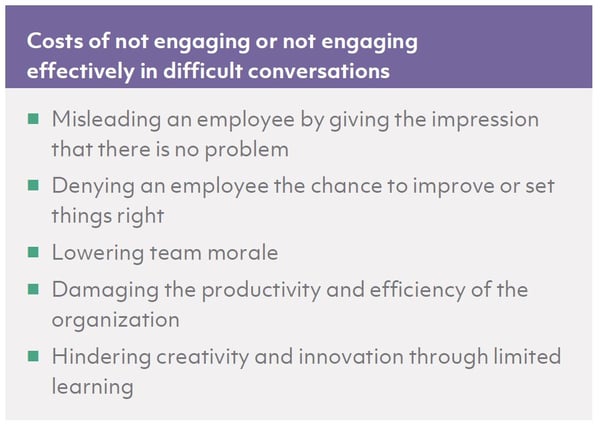
However, the impact of not having these conversations can be just as destructive: problems remain unresolved, negative feelings fester, and relationships are damaged. Additionally, the costs to the broader organization can be quite high—a “nice” or “avoidant” culture with limited engagement, low morale and productivity, and minimal organizational learning that hampers creativity and innovation.
The New York Times bestseller Difficult Conversations: How to Discuss What Matters Most, coauthored by Bruce Patton, former Partner with Vantage, examined these interactions. The authors note that we cannot get rid of difficult conversations—nor should we want to—but we can make them less stressful and more productive. The key to doing this is to turn difficult conversations into more meaningful learning conversations.
A first step in a difficult conversation is finding a mutual purpose
This requires a paradigm shift. Rather than entering a discussion with the purpose of trying to prove a point, or send across a message, a mutual purpose needs to be embraced. The aim is to better understand and acknowledge a counterpart’s interests and how they see the situation, while also caring about one’s own interests. A move from certainty to curiosity is foundational to this paradigm shift.
No one has all the information or really knows what is going on for the other person. You need to get curious and try to understand the other person’s truth—their perception of the situation, the assumptions they are making, and their feelings. As you share your own experience and truth, you can also make sure to consciously acknowledge your assumptions and avoid casting blame. In this way, you can actively engage in a difficult conversation to generate deeper learning, improve relationships, and develop greater confidence in yourself and in your working relationships.
Costs of avoiding or ineffective difficult conversations
Building capability for difficult conversations strengthens culture, performance, and risk-taking
Difficult conversations are particularly challenging to engage in without an organizational culture that encourages individuals to embrace conflict and be open to learning from mistakes. The paradigm shift to a learning conversation requires individuals to become skilled at putting themselves in the shoes of others and demonstrating genuine curiosity about their counterpart, while also becoming better at understanding their own interests, assumptions, and emotions.
We work with clients to train teams to effectively raise difficult topics and engage in productive dialogue so work moves ahead and relationships are strengthened.
Do your teams understand how to:
-
Diagnose individual patterns of communication skills and practice engaging in more balanced conversations?
-
Apply techniques to communicate effectively in the face of disagreement, conflict, and strong emotions?
-
Show empathy with another person’s strong feelings, even while disagreeing with their point of view?
These behavioral skills enhance individual relationships and can lead to concrete business results as individuals are better able to face challenges head on.
Authors: