

Article originally published in the Fall 2026 issue of SAMA Velocity magazine.
New research from Vantage Partners challenges long-held negotiation beliefs and reveals what top performers do differently.
Negotiation sits at the center of almost every critical business relationship, whether between customers and suppliers, partners and stakeholders, or internal and external teams. But despite how often we negotiate, many of the assumptions we carry into those conversations don’t hold up to research.
To better understand what’s actually working in business negotiations, Vantage Partners conducted its latest Customer-Supplier Negotiation Study, gathering insights from more than 400 buy-side and sell-side leaders across industries. The 2026 findings build upon Vantage’s past studies in 2009 and 2018 to identify the behaviors, challenges, and practices that most impact negotiation outcomes today.
What emerged is a clear picture of where organizations are losing value, where top performers are pulling ahead, and which long-held beliefs about negotiation no longer hold up. Understanding these myths can help negotiators and sellers navigate the complexities and market disruptions of the current moment.
Five Negotiation Myths That Don’t Hold up to Research
Myth 1: Nice people finish last
In a volatile market, account managers and sales leaders have a natural tendency to respond combatively and hold tightly to their demands. But the research shows that’s not how negotiators get the best results.
There’s a long-standing belief that to win in a negotiation, you must be tough, even adversarial. But Vantage’s study found that top performers are more collaborative, not less. Nearly 70% of the top quartile of negotiators surveyed said they were “highly collaborative” or “somewhat collaborative,” compared to only 50% of bottom performers.
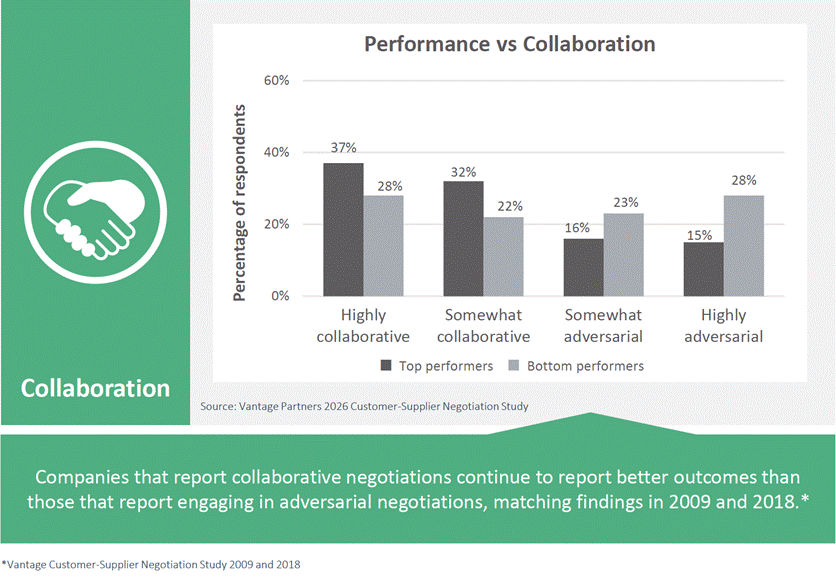
Collaborative negotiators focus on understanding the other side’s priorities, looking for ways to create value, and solving problems together. Collaboration doesn’t mean being soft or giving in. Rather, the most effective negotiators build strong relationships while staying firm on what matters.
To determine if your approach is actually collaborative, ask yourself, “If the other side knows all my tactics or uses the same approach, would that help the situation?” Most likely, if everyone is deploying the same hard-bargaining moves, you won’t get better outcomes, just more friction.
Myth 2: We must give in for the sake of the relationship
Many negotiators worry that pushing too hard will damage the relationship, so they make concessions, like discounts, to keep things smooth. But the data suggests this instinct can backfire. Giving in too easily doesn’t actually lead to faster deals or stronger relationships. Instead, Vantage's 2019 pricing study found that discounts can erode product and service value and have little to no impact on faster close of the deal or customer retention.
Vantage’s negotiation study found that bottom quartile negotiators are 1.5-2x more likely to accept unfavorable terms and conditions for the sake of the customer-supplier relationship, compared to top negotiators. Bottom performers’ top two reasons for discounting are for “price matching” or “fear of losing the deal.”
But that doesn’t mean negotiators should never give discounts or accept unfavorable terms. Rather, consider alternative approaches. When discounts are appropriate, top performers make strategic trades by tying them to volume or longer-term contracts. This way, they protect both the relationship and the value of the deal.
Myth 3: When you know better, you do better
It’s easy to assume that once negotiators understand what drives value, they’ll act accordingly. But the data shows that’s not always the case. Most negotiators recognize that price isn’t the only thing that matters. And yet, in actual negotiations, price still becomes the main focus.
Vantage’s study demonstrates this phenomenon. Out of a list of factors that influence supplier selection, price was ranked #6 and #7 in importance for buy-side and sell-side negotiators, respectively. But an overemphasis on price showed up as one of the biggest barriers to better outcomes. “Focused too much on price” was the #2 barrier for the buy-side and #3 for sell-side.
The study highlights a common organizational challenge: knowing what creates value does not automatically translate into behaviors that support it. In high-pressure situations, people fall back on habits and turn to what feels easiest in the moment. Changing these behaviors is difficult, but deliberate training, persistence, and a supportive environment can help negotiators consistently apply more effective approaches.
Myth 4: We are better than our peers
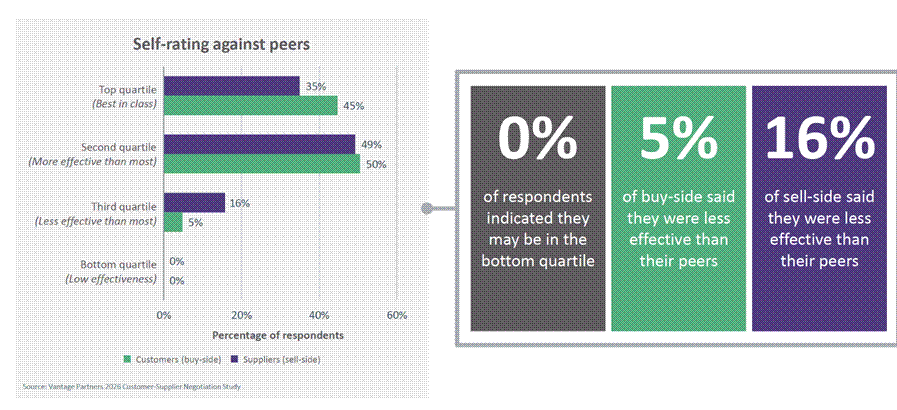
Ask a group of negotiators how they stack up against their peers, and most will say they’re above average. The data backs this up: 0% of respondents believe they fall in the bottom quartile of performers. But statistically, that can’t be true. This kind of overconfidence is a well-documented cognitive bias called the Dunning-Kruger effect, where people tend to overestimate their own abilities.
For organizations, the risk is complacency. If you assume you’re already doing well, you’re less likely to invest in getting better. Top-performing organizations take a more objective view. They regularly assess their capabilities, seek outside perspectives, and look for gaps in how they plan and execute negotiations. That willingness to challenge assumptions and measure performance honestly is a big part of what sets them apart.
Myth #5: Negotiation is only an individual skill
Negotiation is often treated as an individual competency or skill set tied to particularly talented salespeople or executives. But the research suggests that organizational context plays a much larger role in negotiation capability.
Top-performing negotiators were far more likely to report having formal negotiation processes and training in place, rather than relying on individual talent or experience. Vantage’s study found that 53% of top-performing respondents were supported by organizational systems designed to improve negotiation effectiveness, compared to just 19% of lower-quartile negotiators.
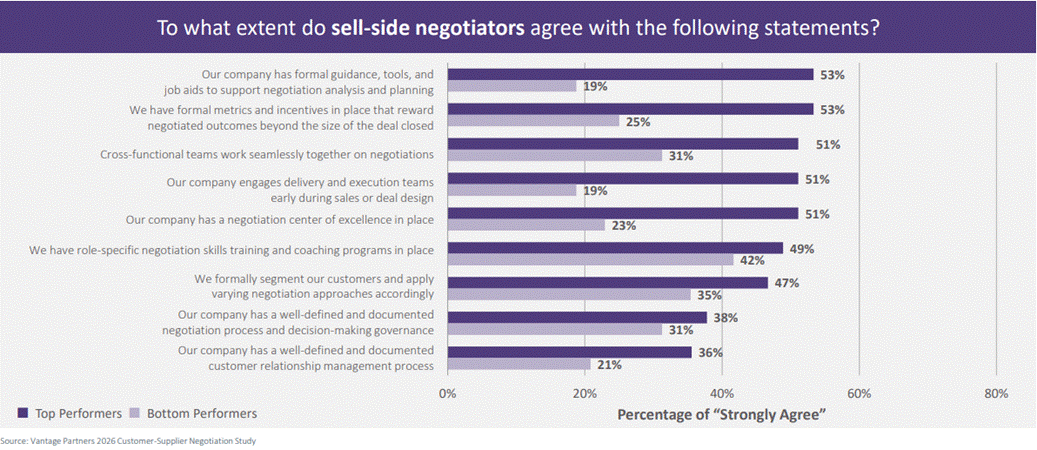
This distinction becomes increasingly important as negotiations grow more cross-functional and complex. Organizations that build negotiation capability broadly through aligned frameworks, incentives, and training are better positioned to protect value across the full lifecycle of customer and supplier relationships.
A Data-Informed Path Forward
The Vantage Partners 2026 Customer-Supplier Negotiation Study shows that many of the biggest barriers to better negotiation outcomes aren’t external. They’re rooted in how organizations approach negotiation itself. From over-relying on price to defaulting to familiar tactics, these patterns can quietly erode value across both negotiation and implementation.
The good news is that the data also points to a different path forward. Top performers approach negotiation as a skill that can be developed and scaled across the organization. They invest in better planning and stronger alignment, and they strike a balance between collaboration and value protection.
As organizations navigate an increasingly complex environment, those that challenge outdated assumptions and invest in building negotiation capability will be better positioned to protect value, strengthen relationships, and deliver more sustainable outcomes.
Explore Vantage Partners' negotiation training and consulting services.
Authors: